|
At the close of entry, we had 526 SS1 entries and 253 SS2 entries. With some 620 individuals entered across both races. Our initial goal, which many made the effort to inform us was unattainable, was 500 in total.
The weather and sea conditions, over the three-day window period, could have been kinder to us, and we were forced to make some decisions that did not please everyone.
We attempted, as far as possible, to stick to the ethos of a downwind race. Hindsight is always an exact science, and fortunately we can quite confidently say that if we were forced to make the same decisions, in retrospect, they would not change.
Many of the international guests took heed of our advice to arrive a few days early (some even a few weeks early). Those who did, reaped the reward of a number of cracker downwinds before they even lined up at the start of the main event.
From an organisers, and competitors’ perspective, it is always best to hold the SS1 race before the SS2 race, as the vast majority of paddlers view the SS1 as the more important of the two. The organisational dilemma presented itself when the best predicted day, of the three-day window period, was viewed to be the last of the three days.
This forced the holding of the SS2 race before the SS1 race, which resulted in a number of the top contenders pulling out of the mixed doubles so as not to compromise their chances the next day. This was unfortunate, but a consequence that the committee was well aware of.
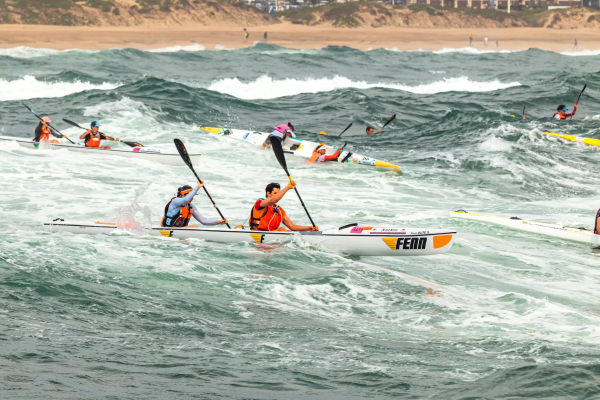
The sea conditions, which greeted the paddlers on the morning of the race, were a far cry from the benign Mediterranean one’s that had prevailed for the week before. A strong NE wind had chopped things up and there were large waves breaking where there rarely are.
The ICF only recognises the mixed doubles as an official SS2 category, so it was here where most of the competition concentrated itself.
The MD were set off first, followed a few minutes later by the rest of the field.
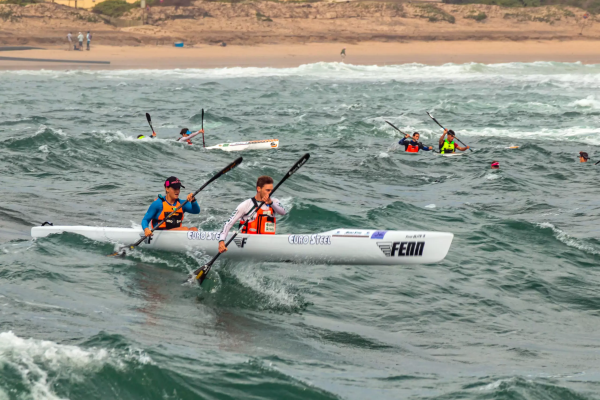
The almost 2km paddle out to the turn buoy was a challenge for many, but once turned, the field revelled in some technical downwind runs.
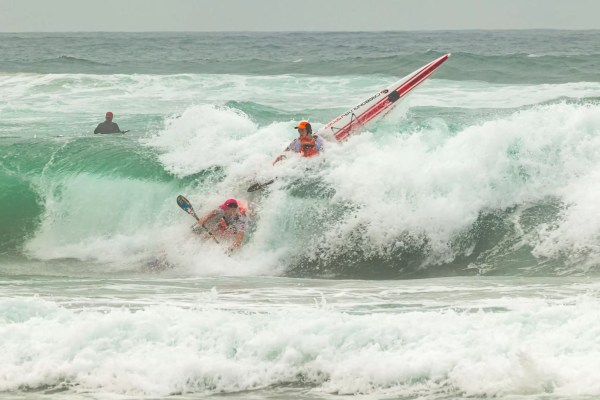
The surf at Amanzimtoti, which had been described, by the locals earlier that morning as “very manageable”, turned into an unpredictable nightmare for many when the wind turned to a strong SW while most of the field was still at sea. This resulted in a fair degree of carnage, including an overturned SAPS rescue boat.
South Africa earned the first of its medals when Matt Fenn and Saskia Hockly hit the beach first, ahead of Thais Delrieux and Hector Henot of France, with Hamish Lovemore and Jenna Nisbet completing the podium.
More medals came the way of SA with Holly Smith and Heath Clarke winning the U23 gold, Ryley Smith and Ellen Strydom winning gold in the junior MD and Madison Fourie and Matthew Coetzer securing the bronze.
The SS1 race, the next day, saw the sea conditions at the start return to their usual benign self.
The women started first with the men a few minutes later.
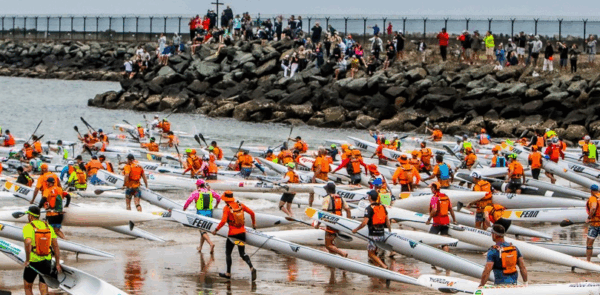
The sight of over 500 paddlers leaving the start line was magnificent.
The predicted strong SW did not materialise, but the conditions gave the skilled downwind experts plenty to work with.
The finish, at Westbrook Beach will be remembered as much for the exciting last few metres of racing, as it will be for the impressive shorebreak that played havoc with many of the uninitiated.
The first person to round the buoy, a couple of hundred metres from the finish arch, was our own Kira Bester, who was holding off a determined charge from the kiwi Danielle Richards, a few waves behind. A swim in the surf line would have easily been enough to throw away the gold. Fortunately she maintained her composure and crossed the line to win back-to-back world titles. Danielle was under no pressure as she beached a full 5 minutes ahead of 3rd place Rosie Edwards from the UK (also winning the U23), with a rampant Georgia Singe a mere 15 seconds behind, in fourth overall and second U23.
Australian, Cory Hill left his move quite late after trailing Frenchman, Pierre Vilella for much of the race. Ultimately he showed why he has won the title on three previous occasions, by romping home to a fourth World Championships title. Pierre remained second with Bernado Periera from Madeira (Portugal) rounding off the podium positions.
For the first time in the history of the World Championships, a South African male was not on the podium, with Nic Notten fourth, followed by last year’s winner, Gordan Harbrecht from Germany.
Kira was not the only back-to-back winner on the day. Last years junior champion, Sam Mocke, produced a “kyk weer” by winning his second junior title. Ellen Strydom ensured that the SA junior women were also represented, with a silver, behind Andrea Colmard from Spain.
Other SA medallists were Matt Coetzer with a silver in the U23 category and Jade Wilson with a bronze un the women's U23.
South Africa did not win as many medals as we would have hoped for, but we made a meal of the team prize with 24 points, the next team having 8.
The event was covered by a live stream, which can be watched on the Planet Canoe YouTube channel
The organising committee has been flooded with messages of congratulations for a well-run event. The real heroes are, however, our sponsors, the boat manufacturers, and our volunteers. Without them, we would have been as unsuccessful as some who braved the Westbrook shorebreak. |